In short
- Rust (the MOT says corrosion) doesn’t fail a car just by being there. Where it is, and how much metal is left, decides the result[1].
- Around the metal that brakes, steering, suspension and seat belts are fixed to, a hole or a soft spot fails the car. That zone reaches 30 cm from each fixing[1].
- Rust that leaves the metal firm and strong isn’t a reason to fail[1]. Most of the commonest rust notes on MOT records are advisories (MOT Wise analysis of DVSA MOT results, 2025).
- A pass doesn’t show a car is free of rust. Paint, underseal and trim can hide it. Testers are told to pass and advise when they can’t tell how a repair was done[1].
- Rust notes are rare on young vehicles and common on old ones (MOT Wise analysis of DVSA MOT results, 2025). They appeared in at least 11.1% of MOTs at age 15, and 0.1% to 0.2% at age 3.
On this page
The MOT is the yearly check that a car is safe and fit for the road. Its word for rust is corrosion. A car doesn’t fail just because there’s rust on it. The manual looks at where the rust is and what that part does[1].
A little rust in a vital spot can make a car unsafe. A lot on a part that carries no load may not. The next sections go through how testers decide.
Can fail the MOT
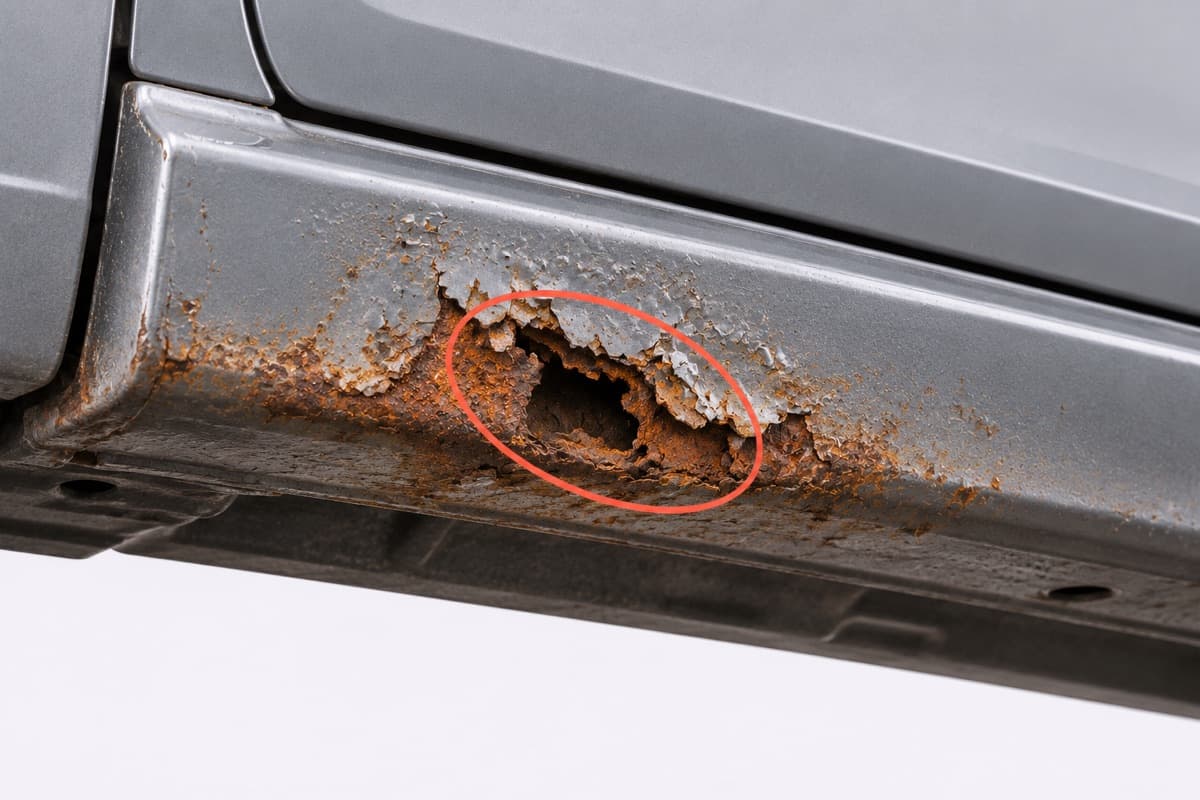
- A hole in the metal in a prescribed area (explained below)[1]
- Metal in a prescribed area that isn’t firm under finger and thumb pressure
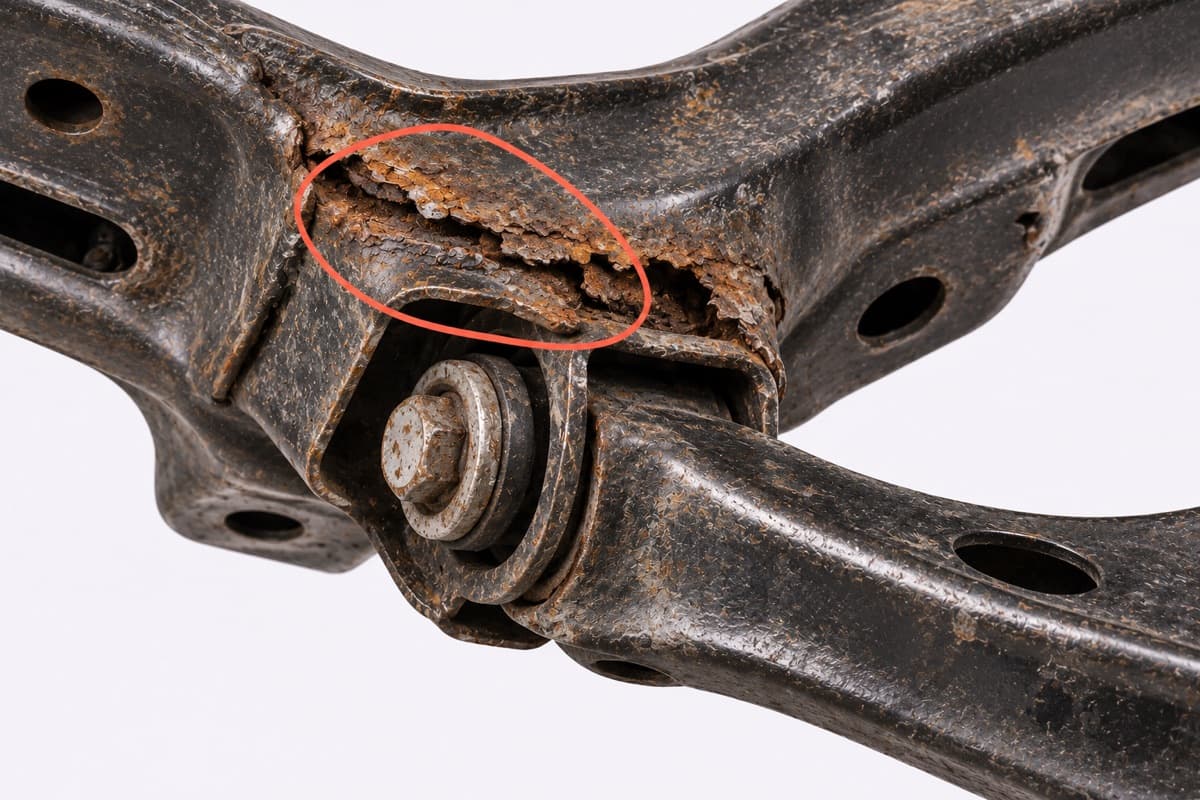
- A suspension arm, rod or lever where rust has seriously thinned the metal, or made a hole or split
- A suspension part or sub-frame that is excessively corroded[4]
- A brake pipe that is excessively corroded[5]
- Structure near a suspension, steering or brake fixing that is significantly weakened
- A floor that is excessively deteriorated[3]
- A poor repair in a prescribed area, such as body filler on load-bearing metal
Passes, and may get an advisory
- Surface rust on metal that is still firm and strong
- Rust on a coil spring or suspension part that hasn’t fractured it or seriously weakened it (the manual’s fail line)[4]
- Rust on a body panel that doesn’t weaken the structure or leave a sharp edge[3]
- Rust outside the prescribed areas that doesn’t affect braking or steering, or the strength of the structure as a whole[2]
- Rust the tester sees but that isn’t bad enough to fail. The manual tells them to mention it to the owner
Testers grade each fault dangerous, major, minor or advisory. The first two fail the car. An advisory is something to keep an eye on. Our guide to minor, major and dangerous MOT faults explains each grade.
Testers can still add an advisory for rust that isn’t bad enough to fail. Our guide to MOT advisories explains what an advisory means for the car.
A prescribed area is the load-bearing part that brakes, steering, suspension, seat belts and other tested equipment are fixed to. It also includes any load-bearing or supporting structure or panelling within 30 cm of that fixing[1].
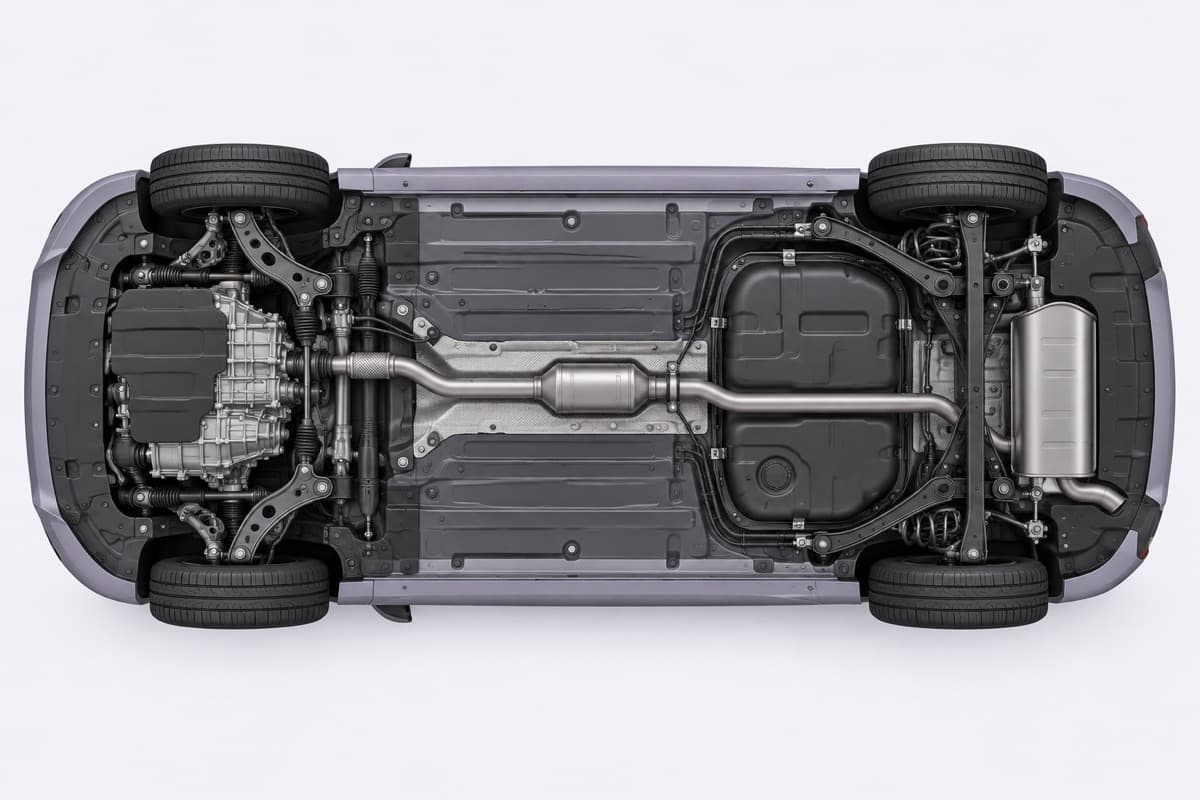
In a prescribed area, the tester rejects corrosion in any of these three cases[1].
- There is a hole in the metal.
- The area doesn’t feel firm under finger and thumb pressure.
- A finger, a thumb or the tester’s corrosion tool makes a hole in it.
The tool is for confirming a failure. It isn’t for heavy scraping or poking[1].
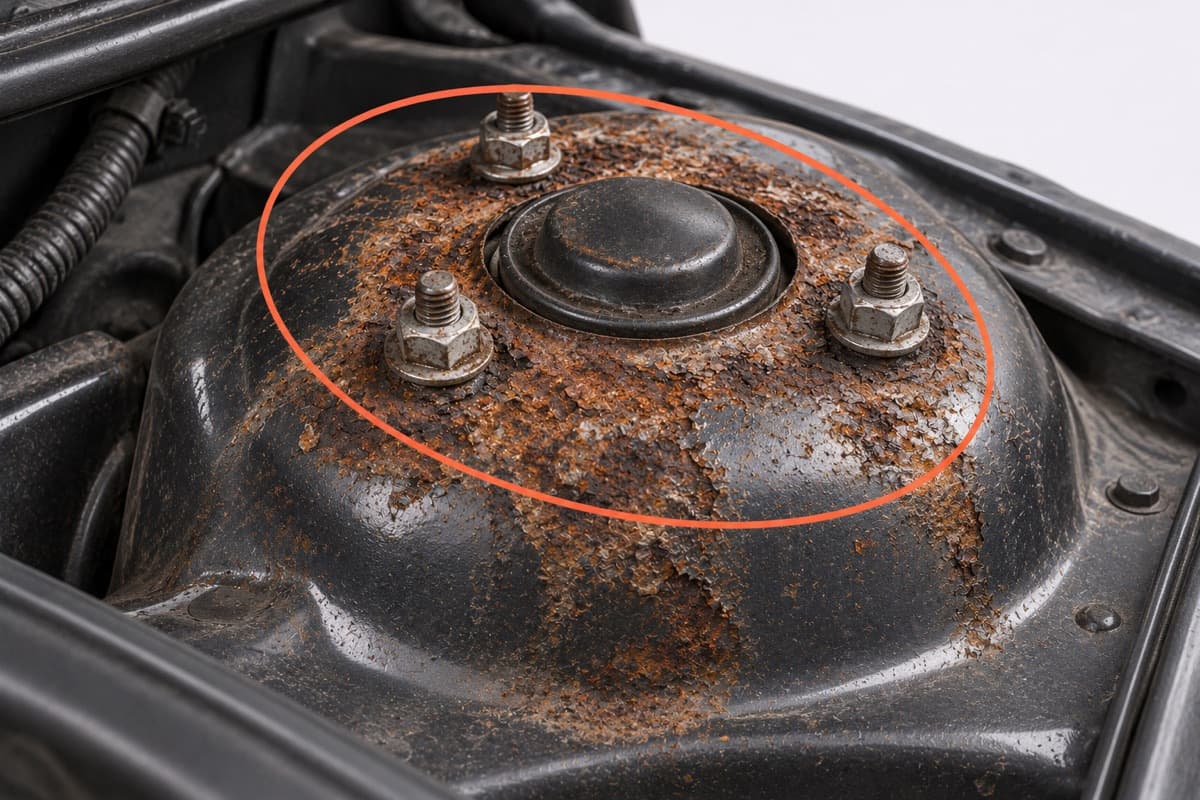
Outside prescribed areas, the rule for the car’s structure is gentler. Corrosion in the structure fails there in two cases only. One is when the structure has moved out of line and affects braking or steering. The other is when the strength of the whole structure is significantly reduced[1]. The grade is major if rigidity is significantly reduced. It is dangerous if steering or braking is likely to be affected[2].
Here is how the manual treats the parts of a car where rust shows up on MOT records.
| Part | What the manual says |
|---|---|
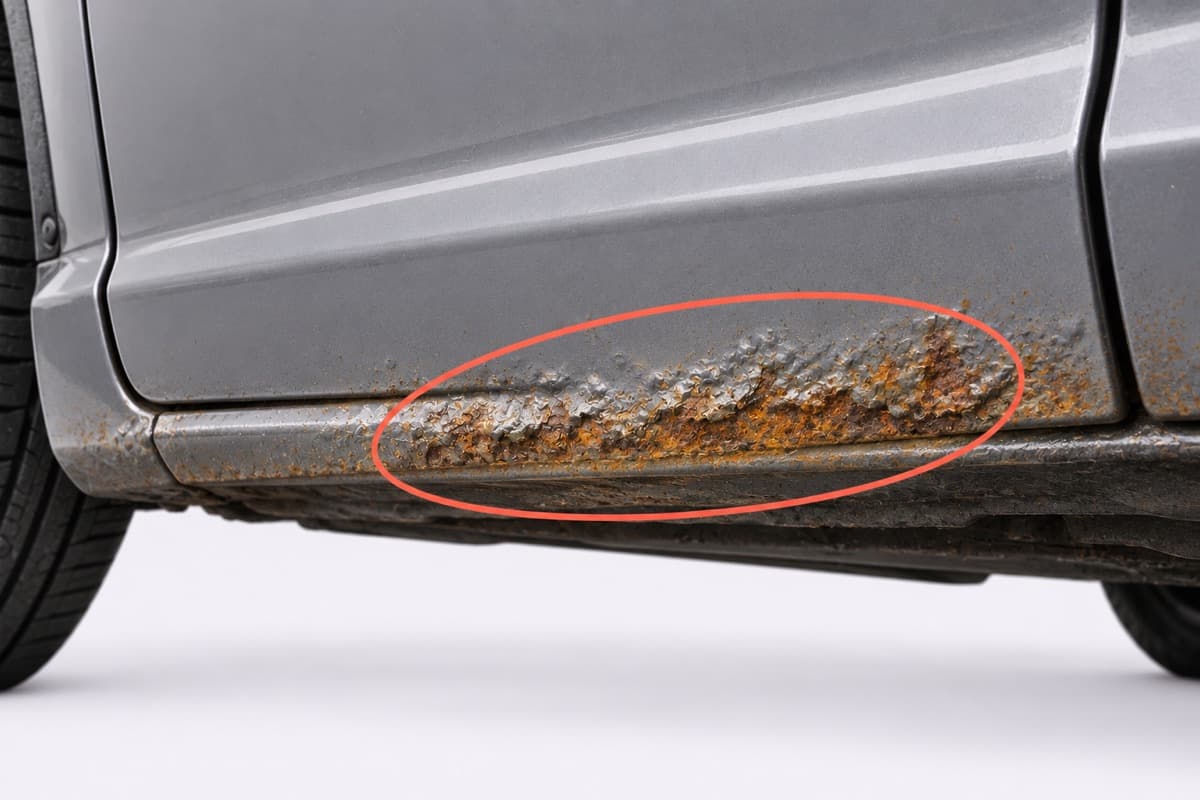
| Sills (below the doors) | There’s no single rule. Whether sill rust matters depends on how the car is built. On some cars the sill is a main load-bearing part, and on others it isn’t. If a seat belt is fixed to an inner sill, the tester also considers the outer sill or reinforcement within 30 cm. |
| Sub-frames and cross members | These thin pressed-steel parts can rot badly in small spots that are hard to see. A part that is excessively corroded is a major fault. One that is fractured or likely to fail is dangerous. |
| Suspension arms, rods and links | These are highly stressed. They fail if rust has seriously thinned the metal, or caused a hole or split. |
| Brake pipes | A wall thinned by about a third can fail a pipe, and excessive corrosion is a major fault. See our guide to brakes and the MOT. |
| Floor | A floor that is excessively deteriorated is a major fault. One so bad it could cause loss of control or injury is dangerous. |
| Body panels | A panel corroded so that touching it could cause injury is a major fault. A panel likely to come off is dangerous. |
From the MOT inspection manual: Appendix A[1], section 5.3[4], section 1.1.11[5] and section 6.2[3].

A repair to a load-bearing part has to be as strong as the original[1]. Patches must be welded along the whole seam. Spot welds are only acceptable where the original was spot-welded and the panel was taken off.
Gas brazing, soldering, glue, fibre reinforcement and body filler aren’t acceptable on load-bearing parts. A method the car’s maker recommends can be accepted. An inadequate repair in a prescribed area is a fail[1].
If a car has had rust repaired, ask who did the work, how they did it, and for the invoice. A repair hidden under paint or underseal is hard for a tester to judge.
Rust holes should be repaired before the area is sealed. Covering a hole makes later welding harder, or impossible[8].
A pass doesn’t show that a car is free of rust. Testers don’t have to check areas covered by trim. When paint or underseal stops them seeing how a repair was done, the manual tells them to pass the car and advise[1]. DVSA, the government agency that runs the MOT, accepts on its testers’ blog that corrosion can be hidden or hard to reach[6].
Underseal is a protective coating on the underside. Cracked underseal can let water back in to the metal[8]. A fresh coat can also hide rust and repairs. The manual tells testers to pass and advise when underseal hides how a repair was done[1]. So a fresh coat on an older car deserves a question: what is under it, and when was it put on?
Myth
Any rust fails the MOT.
What's true
Rust being there isn’t the test. Where it is, and the condition of the metal, decide the result.
Myth
A fresh MOT means the car is rust-free.
What's true
Trim and underseal can hide rust and repairs. The tester is told to pass and advise when they can’t tell how a repair was done[1].
Myth
Testers aren’t allowed to scrape underseal.
Myth
A hole in a sill is always a fail.
What's true
It depends on how the car is built, and on whether the sill is in a prescribed area.
Rust notes are rare on young vehicles and common on old ones. These figures count rust notes among each age’s 100 commonest items. They are about coil springs, sub-frames, axles, mountings, brake pipes and hose fittings, body structure and chassis. They cover all MOT-tested vehicles (MOT Wise analysis of DVSA MOT results, 2025).
- Age 3
- 0.1%
- Age 5
- 0.6%
- Age 7
- 1.9%
- Age 10
- 5.3%
- Age 12
- 8.3%
- Age 15
- 11.1%
- Age 17
- 11.5%
- Age 20
- 15%
- Age 25 and over
- 10.4%
All MOT-tested vehicles, 2025. Share of MOTs at that age where the commonest single rust note was recorded at any grade. Other rust notes add to it, so the true share is at least this high. MOT Wise analysis of DVSA MOT results, 2025.
Read the chart as a minimum. Add up every rust note among the commonest items and age 12 could reach about 1 in 4 MOTs (24.3%). Some MOTs have more than one note, so that is the most those notes could add up to. The figure falls back at 25 and over. The vehicles still being tested at that age are a different mix, and the data doesn’t say why. This is MOT Wise analysis of DVSA MOT results, 2025.
| Age | MOTs with a rust note: at least | At most (commonest items) | Advisory records per 100 MOTs | Fail records per 100 MOTs |
|---|---|---|---|---|
| 3 | 0.1% | 0.2% | 0.1 | 0.1 |
| 5 | 0.6% | 1.1% | 0.9 | 0.5 |
| 7 | 1.9% | 3.9% | 4.0 | 1.7 |
| 10 | 5.3% | 14% | 17.3 | 3.5 |
| 12 | 8.3% | 24.3% | 31.4 | 5.1 |
| 15 | 11.1% | 38.9% | 51.5 | 8.0 |
| 17 | 11.5% | 47.4% | 62.2 | 10.1 |
| 20 | 15% | 54.8% | 74.7 | 11.8 |
| 25 and over | 10.4% | 37.4% | 49.9 | 11.1 |
All MOT-tested vehicles, 2025. “At most” adds every rust note among the commonest items, so a vehicle with two is counted twice. The records per 100 MOTs are a minimum, because only the commonest items are counted. A record is one line on an MOT, so a vehicle with two rusty parts has two records. Fail records are lines marked major or dangerous. “Advisory” includes faults fixed during the test. MOT Wise analysis of DVSA MOT results, 2025.
Among the commonest items, most rust notes are advisories. At age 12, rust notes made at least 31.4 advisory records per 100 MOTs, against at least 5.1 fail records. This is MOT Wise analysis of DVSA MOT results, 2025.
DVSA’s own tables can’t give one rust figure, because rust in prescribed areas is counted under suspension, steering, brakes and seat belts. Structural rust sits in the “body, chassis and structure” category. That category had a fail-level fault in about 1 in 30 first-time MOTs (3.4%). This is DVSA data for cars and light vans, April 2024 to March 2025[9].
Testers write rust as “corroded” or “corrosion”. If a note says a part is corroded but not seriously weakened, the rust hadn’t weakened it enough to fail. Among the commonest rust notes, most are advisories (MOT Wise analysis of DVSA MOT results, 2025).
| What the tester wrote | MOTs where it was recorded | Advisory | Fail |
|---|---|---|---|
| Coil spring corroded | about 1 in 20 MOTs (5.5%) | 73% | 27% |
| Suspension part or sub-frame corroded, but not seriously weakened | about 1 in 20 MOTs (4.6%) | 96% | 4% |
| Brake pipe corroded or covered in grease | about 1 in 20 MOTs (4.6%) | 90% | 10% |
| Body structure corroded, but not seriously weakened (a minimum) | about 1 in 75 MOTs (1.3%) | 81% | 19% |
| Structure or chassis corroded within 30 cm of a mounting, but not seriously affecting overall security (a minimum) | about 1 in 300 MOTs (0.3%) | 64% | 36% |
All MOT-tested vehicles aged 3 and over, 2025. Each MOT is counted once if the note was recorded at any grade. The last two columns split that note’s records. The same code covers the advisory and the fail, so the fail share is the serious version of each note. That means metal weakened enough to fail. “A minimum” means the note is not among the 100 commonest at every age. “Advisory” includes faults fixed during the test. MOT Wise analysis of DVSA MOT results, 2025.
The thing to ask about is rust that comes back. If the same rust note appears test after test, ask whether it was repaired. A rust fail followed by a pass should come with an invoice that shows what was done.
A dangerous fault caused by rust is the most serious grade. It could be a structure weak enough to affect steering or braking. If the record shows one, ask what was done about it, who did the work, and for the paperwork.
Our guide to what a good MOT history looks like shows how rust fits into the whole record. The risk rating guide explains how we weigh a car’s full history.
You don’t need to be a mechanic. Take a torch, and ask to see the car on a ramp if you can. Our guide to questions to ask a seller has more for the conversation.
Checking for rust at a viewing
0 of 11 done
Common questions
How much rust is allowed on an MOT?
There’s no set amount. Where brakes, steering, suspension or seat belts are fixed, a hole or a soft spot fails the car. So does one within 30 cm. Elsewhere, rust in the structure fails only if it affects braking or steering, or significantly weakens the whole structure. Rusty panels and parts have their own rules. A panel with an edge that could injure someone fails.
Will surface rust fail an MOT?
Not if the metal underneath is still firm and strong. The tester may note it as an advisory, so the owner knows to keep an eye on it.
Does a rusty sill fail an MOT?
It depends. There’s no single rule for sills. On some cars the sill is a main load-bearing part, and on others it isn’t. A sill that holds a fixing for a seat belt or other tested equipment is judged more strictly.
Can an MOT tester see rust under underseal?
Not always. Testers don’t have to check areas covered by trim. If paint or underseal hides how a repair was done, they are told to pass the car and advise. They may use a corrosion tool to confirm a failure, but not for heavy scraping.
Do rust repairs have to be welded?
On load-bearing parts, yes. Patches must be welded along the whole seam. Body filler, soldering, gas brazing and fibre reinforcement aren’t acceptable there, and other methods only if the car’s maker recommends them. A poor repair in a prescribed area is a fail.
Sources
- MOT inspection manual: Appendix A, Structural integrity and corrosion. DVSA, 2026.
- MOT inspection manual: 6.1 Structure and attachments. DVSA, 2026.
- MOT inspection manual: 6.2 Body and interior. DVSA, 2026.
- MOT inspection manual: 5.3 Suspension. DVSA, 2026.
- MOT inspection manual: 1.1.11 Rigid brake pipes (and 1.1.21). DVSA, 2026.
- Why it’s important to check for corrosion. DVSA, Matters of Testing blog (GOV.UK), 2018.
- Car rust guide: how to remove and prevent it. RAC Drive, 2026.
- Car underseal rust protection: what is it and is it worth getting for your car?. Auto Express, 2025.
- MOT class 3 and 4 vehicles: initial failures by defect category (DVSA/MOT/03). DVSA, 2026. Cars and light vans, first tests only, April 2024 to March 2025.