In short
- The legal minimum tread depth is 1.6 mm, across the central three-quarters of the tyre and all the way round[1].
- Tread below that limit is a dangerous fault. The car fails, and GOV.UK says not to drive it until it is repaired[2].
- Cuts that show cord, bulges, different sizes on one axle and a faulty pressure warning system also fail the car[1].
- These don’t fail a car: a worn outer quarter of the tread or the spare[1]. Mixed brands aren’t listed as a fault, and the tyre-age check isn’t for cars[1].
- Tyres were 60.1% of all dangerous faults in first-time MOT figures for April 2024 to March 2025[11]. The figures come from DVSA, the government agency that runs the MOT.
On this page
- What is the legal tyre tread depth for an MOT?
- What else can fail a tyre at an MOT?
- Does the tyre pressure warning light fail an MOT?
- Tyre myths, checked against the manual
- How often do tyres fail the MOT?
- What tyre notes on an MOT history look like
- How old can tyres be?
- How to check a used car’s tyres
- Common questions
- Sources
The MOT is the yearly check that a car is safe and fit for the road. For tyres, the main rule is easy to state. The main grooves must be at least 1.6 mm deep, across the central three-quarters of the tread and all the way round[1].
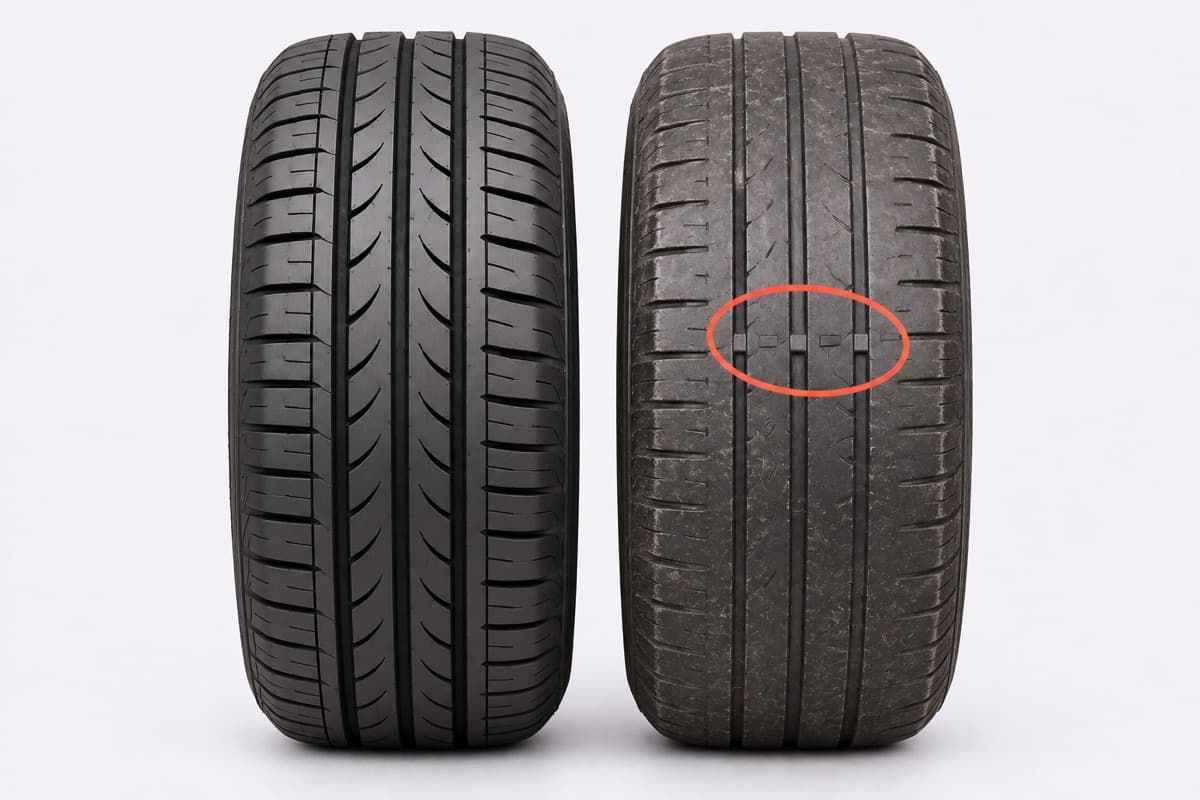
So the outer quarter of the tread, split between the two edges, can be worn smooth without failing. Shallow secondary grooves and wear bars are ignored too[1]. Only the main grooves are measured.
TyreSafe, a road safety charity, describes the penalty as up to £2,500 and three points per tyre[7]. The law adds points differently when several offences happen on one occasion. The total is normally the highest single figure, not the sum, unless the court decides otherwise[6].
Testers give each fault a grade. Dangerous and major faults fail the car. Minor faults and advisories don’t, though they are still written on the record[2]. Our guide to minor, major and dangerous MOT faults explains each grade.
| Fault | In plain words |
|---|---|
| Tread below 1.6 mm in the central three-quartersGrade: Dangerous | The car fails and should not be driven until the tyre is replaced. |
| A lump, bulge or tear, or damaged or exposed cordGrade: Dangerous | The structure of the tyre has begun to separate or fail. |
| A tyre valve badly damaged or out of lineGrade: Dangerous | The tyre is likely to go flat suddenly. |
| A cut that shows cord or plyGrade: Major | Fails if cord or ply shows, even once the cut is opened up. A cut over 25 mm or 10% of the tyre’s width (whichever is bigger) also fails if cord can be felt. |
| Different sizes on the same axleGrade: Major | The two tyres on one axle must be the same size. |
| Radial and cross-ply tyres on the same axleGrade: Major | The two tyres must be built the same way. |
| A tyre rubbing on part of the carGrade: Major | Fails if it is rubbing at the time of the test. |
| A tyre not seated properly on its rimGrade: Major | The tyre is not sitting properly on the wheel. |
| Pressure warning system faulty or obviously not workingGrade: Major | Checked on cars first used on or after 1 January 2012. See the next section. |
| A tyre that is obviously under-inflatedGrade: Minor | The car passes. The fault is still written on the record. |
Grades from the MOT inspection manual, section 5.2.3[1].

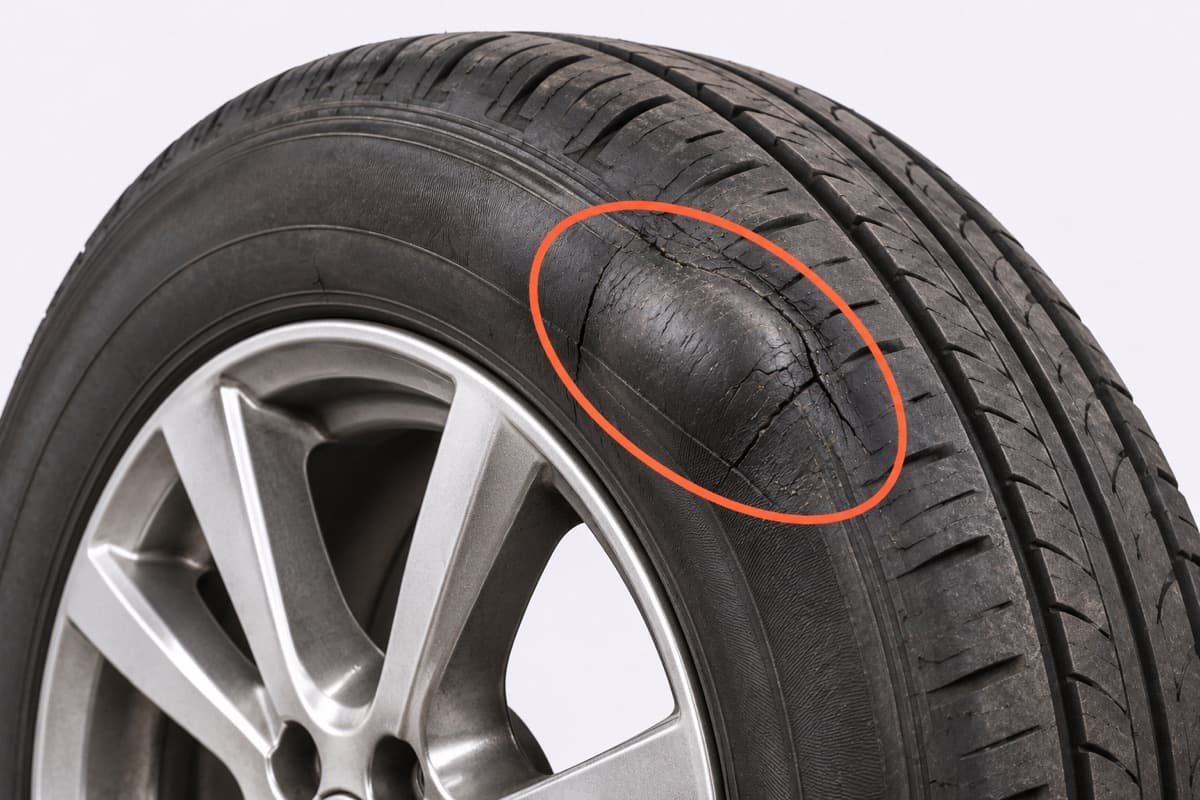
Different brands or tread patterns on one axle aren’t listed as a fault. Different sizes are[1]. Cracked or perished rubber isn’t a separate fail item in the manual either. Testers do write it down, though, and we show how often below.
Many cars have a system that warns the driver when a tyre is losing air. The MOT checks it on cars first used on or after 1 January 2012[1].
A system that is faulty, or obviously not working, is a major fault and the car fails[1]. A lit light on its own isn’t a fault, as it may just mean a tyre has lost pressure. On many cars a fault shows as a light that flashes a few times and then stays on[1]. If the tester can’t tell the difference, they add an advisory. A message on the dashboard isn’t a defect by itself.
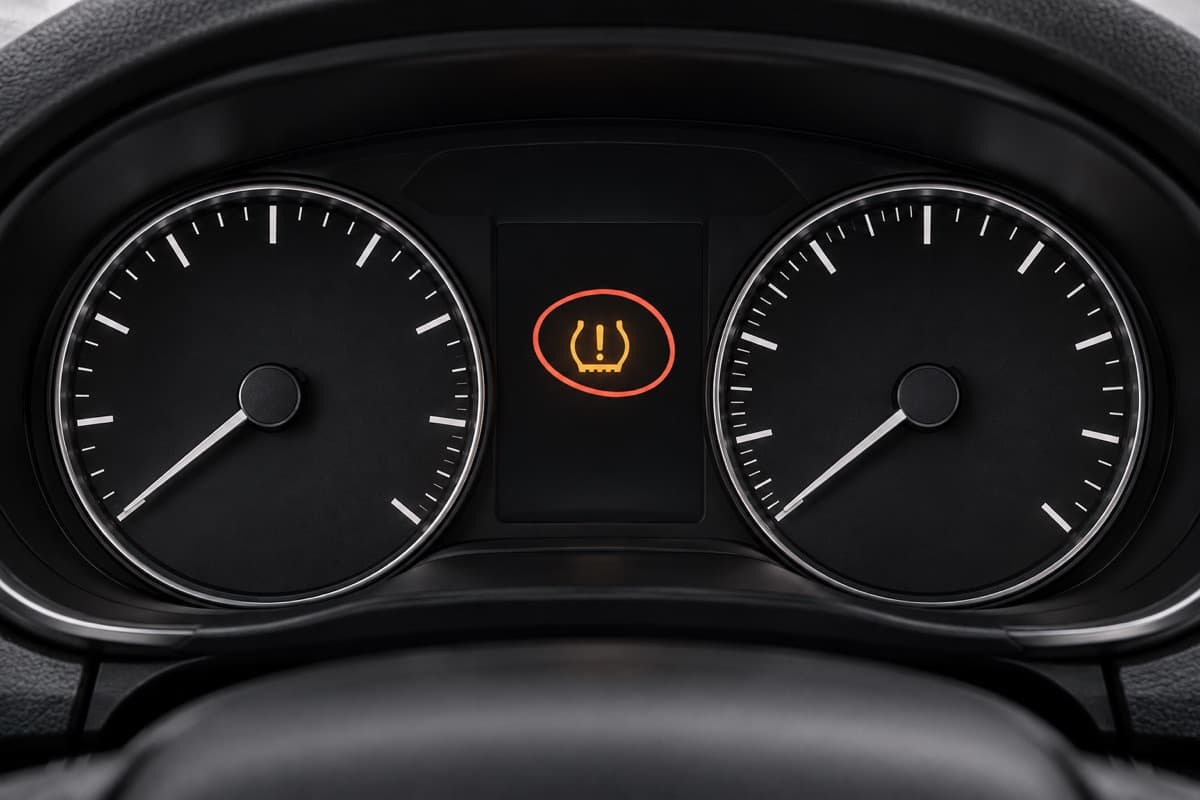
Some websites say this light never fails an MOT, or that it is only a minor fault. The manual says major, so that is what we use. On a car you’re viewing, ask about a pressure light that stays on while you drive. It could be a slow puncture, or a fault in the system.
Myth
The legal limit is 3 mm.
What's true
The legal limit is 1.6 mm. Experts advise changing tyres sooner. TyreSafe says 3 mm is the depth commonly advised. It cites tests with up to 44% longer braking distances in the wet at 1.6 mm than at 3 mm[7].
Myth
A bald edge fails the MOT.
What's true
Only the central three-quarters of the tread is measured. The outer quarter can be worn smooth[1].
Myth
Tyres over 10 years old fail the MOT.
Myth
The tester checks your spare tyre and the tyres’ speed and load ratings.
What's true
Not on a car. Only the tyres fitted to the road wheels are inspected, and a fault on the spare is only mentioned to the owner. Speed and load ratings are checked only on large passenger vehicles (13 seats and more) and vans of 3,000 to 3,500 kg[1].
Tyres cause more of the most serious MOT faults than any other part. These are DVSA’s figures for first-time MOTs: the first test of each MOT, not the retests that follow. They cover cars and light vans.
- 60.1%
- of all dangerous faults were tyre faults
- Brakes came second, at 29.0%. DVSA MOT testing data, Table 03 (classes 3 and 4, initial tests), April 2024 to March 2025[11].
- 4.7%
- of first-time MOTs had a dangerous tyre fault
- Same data and period.
- 6.4%
- of first-time MOTs had a tyre fault bad enough to fail the car
- A major or dangerous tyre fault. Same data and period.
Put another way, a tyre fault that fails the car turned up in about 1 in 15 first-time MOTs (6.4%). A dangerous one turned up in about 1 in 20 first-time MOTs (4.7%). Tyres and brakes together make up about 89% of dangerous faults, so they are the two parts to look at first. Our guide to brakes and the MOT covers the other one.
Most of the commonest tyre notes on a record are advisories, not fails. An advisory means the tester saw wear or damage that hadn’t reached the point of failing. Here are five tyre notes that come up often, across all MOT-tested vehicles (MOT Wise analysis of DVSA MOT results, 2025).
| What the tester wrote | MOTs where it was recorded | Advisory | Fail |
|---|---|---|---|
| Tyre worn close to the legal limit, or worn on the edge | about 1 in 5 MOTs (18.8%) | 92% | 8% |
| Tyre slightly damaged, cracking or perishing | about 1 in 9 MOTs (10.8%) | 86% | 14% |
| Tyre has a cut that does not reach the cords | about 1 in 40 MOTs (2.4%) | 58% | 42% |
| Nail in tyre | 1.6% of MOTs | 100% | 0% |
| Pressure warning system faulty or obviously not working (a minimum) | about 1 in 300 MOTs (0.4%) | 21% | 79% |
All MOT-tested vehicles aged 3 and over, 2025. Each MOT is counted once if the note was recorded at any grade. The last two columns split that note’s records. The same code covers the advisory and the fail, so the fail share is the serious version of each note. For the first row that is tread below the limit. For the second it is a bulge, tear or exposed cord. “Advisory” includes faults fixed during the test. The pressure warning figure is a minimum, because it is not among the 100 commonest notes at every age. MOT Wise analysis of DVSA MOT results, 2025.
The note about wear close to the limit is more common at older ages. It was recorded in about 1 in 7 MOTs (14.2%) at age 3. At age 17 it was about 1 in 5 MOTs (21.6%) (MOT Wise analysis of DVSA MOT results, 2025).
- Age 3
- 40%
- Age 5
- 32%
- Age 7
- 24%
- Age 10
- 17%
- Age 12
- 12%
- Age 15
- 10%
- Age 17
- 9%
- Age 20
- 7%
- Age 25 and over
- 4%
All MOT-tested vehicles, 2025. Tyres as a share of the failure records among each age’s 100 commonest MOT items. One vehicle with two bad tyres counts twice. MOT Wise analysis of DVSA MOT results, 2025.
Among the commonest items, tyres make up the biggest share of failure records at younger ages. At older ages, suspension takes a bigger share (MOT Wise analysis of DVSA MOT results, 2025). If the latest MOT lists tyres close to the limit, you may need new ones soon. Ask whether they have been changed since.
A tyre fail followed by a pass doesn’t show what was done, so ask for the receipt. A dangerous tyre fault, such as a bulge, is the most serious grade. If the record shows one, ask what was done about it, and ask for the paperwork. Our guide to MOT advisories explains how to read the rest.
There’s no legal age limit for car tyres[9]. The MOT’s tyre age check is for vehicles with more than 8 passenger seats[1]. The ban on tyres over 10 years old covers heavy vehicles and some minibuses, from 1 February 2021[8].
Advice is stricter than the law. The AA suggests a professional check about every five years[9]. Michelin advises a yearly check once tyres are five years old, and replacement 10 years after they were made, spares included[10].
Tyres can age without wearing out. A car that does few miles, or a spare that is never used, can have deep tread on old rubber. Cracks in the sidewall are a common sign[9].
To find a tyre’s age, look on the sidewall for a four-digit date code, usually after the letters DOT. The first two digits are the week and the last two are the year, so 0720 means the seventh week of 2020. A three-digit code means the tyre was made before 2000[9].
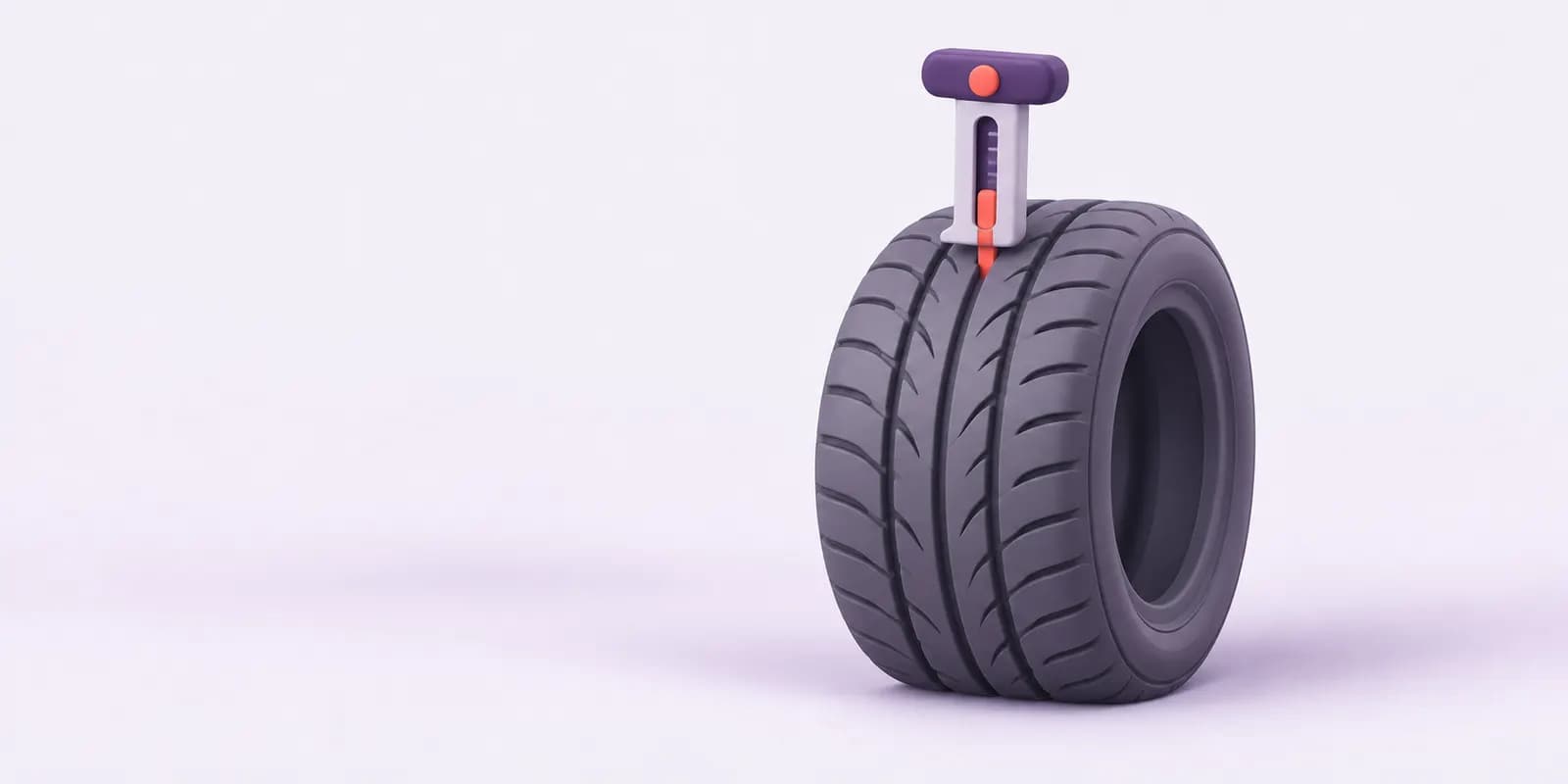
You can check a used car’s tyres yourself. You need a torch and a tread depth gauge. Our pre-MOT checks guide shows what owners can check before a test.
Checking tyres at a viewing
0 of 11 done
Common questions
What is the legal tyre tread depth for the MOT?
It is 1.6 mm in the main grooves, across the central three-quarters of the tread and all the way round. A tread gauge is the easy way to check. Tread below the limit is a dangerous fault and the car fails. Experts advise changing tyres before they reach the limit.
Do tyres have to match for the MOT?
The two tyres on one axle must be the same size, and both built the same way (radial or cross-ply). Brands and tread patterns don’t have to match.
Can a car fail the MOT for old or cracked tyres?
Not for age. The MOT’s tyre age check is for vehicles with more than 8 passenger seats. Cracking isn’t a separate fail item in the manual, but a tyre with cord showing, a bulge or a tear fails.
Is the spare tyre checked in an MOT?
No. Only the tyres fitted to the road wheels are inspected. If the tester notices a fault on the spare, they only tell the owner.
What is the fine for illegal tyres?
In England, Scotland and Wales, the most a court can fine for a car is £2,500 (as of 10 October 2026). The offence carries 3 penalty points, and the court can also ban the driver. Several illegal tyres found on the same occasion do not normally add up to 12 points. Points for offences on one occasion are usually the highest single figure, unless the court decides otherwise. This is general information, not legal advice.
Sources
- MOT inspection manual: 5.2.3 Tyres. DVSA, 2026.
- MOT rule changes: 20 May 2018. GOV.UK (DVSA), 2018.
- Road Traffic Offenders Act 1988, Schedule 2 (entry for Road Traffic Act 1988 section 41A). legislation.gov.uk.
- Sentencing Act 2020, section 122 (the standard scale of fines for summary offences). legislation.gov.uk.
- Criminal Procedure (Scotland) Act 1995, section 225 (the standard scale of fines in Scotland). legislation.gov.uk.
- Road Traffic Offenders Act 1988, section 28. legislation.gov.uk.
- Tyre Tread Depth: Legal Limit & How to Check. TyreSafe, 2026.
- Ban on tyres over 10 years old for heavy vehicles and some minibuses. DVSA, Moving On blog (GOV.UK), 2020.
- Tyre age: how old are my tyres?. The AA, 2025.
- How long do tyres last?. Michelin UK, 2025.
- MOT class 3 and 4 vehicles: initial failures by defect category (DVSA/MOT/03). DVSA, 2026. Cars and light vans, first tests only, April 2024 to March 2025.