
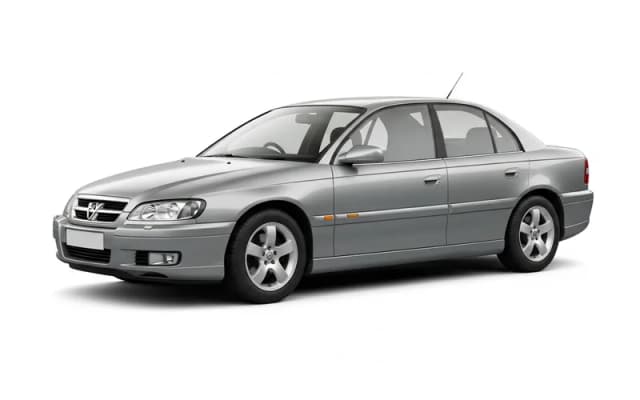
Vauxhall Omega B (1994-2003) reliability
Vauxhall Omega B built around 2003: not enough MOT data yet
We've only seen a handful of Vauxhall Omega Bs built around 2003 so far. Too few to spot a pattern yet.
Looking at a Vauxhall Omega B?
Enter its number plate to see its full MOT history, risk rating and running costs.
Key figure
Check a car’s number plate to see its own MOT record, or come back when there’s more MOT history.
Based on 1,016 tests of Omega models registered 1994-2003.
B fail rate by age
Fail rate is the share of MOT tests that ended in a fail. Retests count as tests. How we count fail rates Build years are worked out from age, so they are approximate. Tests counted are 2025 MOTs. Highest fail rate at 22 years old.
How the Omega B compares
At each age below, see how the Omega B holds up against other cars the same age. The averages combine all fuel types.
Based on 18,327 tests across 9 Vauxhall models, built around 2003 (22 years old).
Fail rate is the share of MOT tests that ended in a fail. Retests count as tests. How we count fail rates Build years are worked out from age, so they are approximate. Tests counted are 2025 MOTs.
What to check before viewing
The model's most common MOT issues, turned into things you can ask about or look for.
Brake pipes and hoses
High priorityLook under the car for corrosion or chafing on the rigid brake pipes near the rear axle.
Brake discs
High priorityAsk for the date and mileage of the last disc replacement; visually check for a deep wear lip and rust pitting on each disc.
Suspension
Worth checkingInspect the suspension carefully and ask the seller for repair history.
Suspension bushes and joints
Worth checkingListen for knocks over speed bumps and ask about recent control-arm or anti-roll-bar work.
Leaks
Worth checkingInspect the leaks carefully and ask the seller for repair history.
Vehicle-specific check
Worth checkingCheck the car’s number plate on MOT Wise to see its own MOT history and any recalls for its build years.
Other saloons to compare
Other saloons, with each one's figures taken at the same age as the Omega B.
- 1

BMW 3 Series
Same body type, tested at the same age
- Fail rate
- 26.3%
- Still registered at 10 years
- 89.8%
No clear edge over the Vauxhall Omega B on these figures.
15 critical recall campaigns matching this model/build period.
10,861 MOT tests on cars built around 2003
- 2

Lexus IS
Same body type, tested at the same age
- Fail rate
- 28.6%
No clear edge over the Vauxhall Omega B on these figures.
2 critical recall campaigns matching this model/build period.
1,214 MOT tests on cars built around 2003
- 3

Audi A4
Same body type, tested at the same age
- Fail rate
- 29.6%
- Still registered at 10 years
- 85%
No clear edge over the Vauxhall Omega B on these figures.
4 critical recall campaigns matching this model/build period.
3,000 MOT tests on cars built around 2003
- 4

Mercedes-Benz C-Class
Same body type, tested at the same age
- Fail rate
- 29.5%
- Fail, no pass in 3 days
- 8.5%
- Dangerous
- 6.5%
- Still registered at 10 years
- 86.7%
No clear edge over the Vauxhall Omega B on these figures.
8 critical recall campaigns matching this model/build period.
3,596 MOT tests on cars built around 2003
- Fail rate
- = the share of MOT tests that ended in a fail. Retests count as tests.
- Fail, no pass in 3 days
- = the share of MOT tests that failed and still hadn't passed 3 days later. A fail that passed a retest within 3 days, even the same day, isn't counted.
- Dangerous
- = the share of MOT tests where the tester marked a fault as dangerous. It is against the law to drive the car until it is fixed.
- Still registered at 10 years
- = the share of cars still registered (taxed or declared off the road) 10 years after they were first registered.
Recall context
2 recalls in all1 of the 2 Omega B recalls covers cars built in these years.
- 1 recall
Top concerns
- 1) possible static sparking during refuelling (astra models only) 2) air bag system may not deploy
For the exact car, check GOV.UK's recall checker with the number plate.
What has gone wrong on Omega B cars built around 2003
The share of petrol cars that have ever failed an MOT on each part of the car. Based on 309 cars.
Rust, which the MOT calls corrosion: 17% of these cars show rust-related issues at this age.
Check the sills, subframe and brake pipes before you decide.
How Omega B cars have aged
How Omega B cars have aged
How fail rates have changed as these cars got older. Each line follows cars first registered in about the same year across several years of MOT data. Not a prediction for any one car.
How each part holds up as B cars age
How each part holds up as B cars age
The share of petrol cars built pre-2005 that have ever failed an MOT on each part of the car. Rates usually rise with age, but can dip slightly as cars leave the road.
| Part of the car | 22 years | 23 years | 24 years |
|---|---|---|---|
| Suspension | 66% | 64% | 62% |
| Brakes | 41% | 40% | 46% |
| Emissions | 46% | 43% | 46% |
| Tyres | 55% | 52% | 53% |
| Lighting | 50% | 47% | 48% |
| Bodywork | 4% | 4% | 3% |
| Steering | 10% | 8% | 15% |
| Corrosion | 17% | 15% | 11% |
Based on petrol cars in the pre-2005 build-year band, from 309 to 598 cars at each age.
B variants compared
Most common issues on Vauxhall Omegas of this age
This list covers every Vauxhall Omega built around 2003, whichever generation it is. We don't have a defect list for the B on its own.
Most common advisories and fails
In order of the share of MOT tests that recorded each one
- 129.0%Advisory
Brake pipe corroded or covered in grease
- 224.3%Advisory
Oil leak, but not excessive
- 317.0%Advisory
Brake disc worn, pitted or scored, but not seriously weakened
- 416.3%Advisory
Suspension mounting area corroded, but not seriously
- 515.7%Advisory
Tyre worn close to the legal limit or worn on the edge
Based on 300 tests
Looking at a Vauxhall Omega B?
Enter its number plate to see its full MOT history, risk rating and running costs.
Frequently asked questions
Built around 2003 (22 years old), the Vauxhall Omega B (1994-2003) fails MOTs noticeably less often than typical for this age. This is based on 300 22-year-old MOT tests from DVSA data. Each retest counts as a test.