
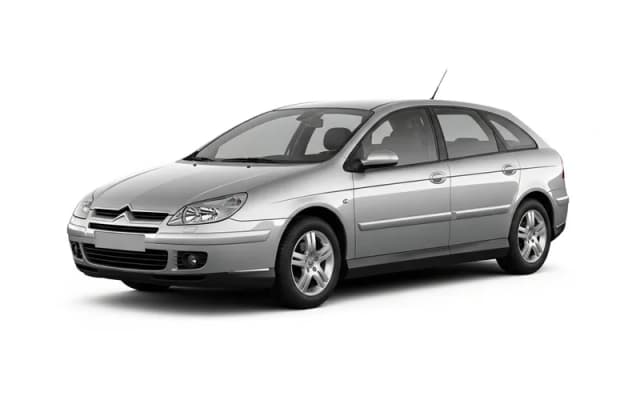
Citroen C5 Mk1 (facelift) (2004-2007) reliability
Citroen C5 Mk1 (facelift) built around 2007: not enough MOT data yet
We've only seen a handful of Citroen C5 Mk1 (facelift) models built around 2007 so far. Too few to spot a pattern yet.
Looking at a Citroen C5 Mk1 (facelift) right now?
Enter its number plate to see its full MOT history, risk rating and running costs.
Key figure
Check a car’s number plate to see its own MOT record, or come back when there’s more MOT history.
Based on 1,421 tests of C5 models registered 2004-2007.
Mk1 (facelift) fail rate by age
Fail rate is the share of MOT tests that ended in a fail. Retests count as tests. How we count fail rates Build years are worked out from age, so they are approximate. Tests counted are 2025 MOTs. Highest fail rate at 17 years old.
How the C5 Mk1 (facelift) compares
At each age below, see how the C5 Mk1 (facelift) holds up against other cars the same age. The averages combine all fuel types.
Based on 31,177 tests across 11 Citroen models, built around 2007 (18 years old).
Fail rate is the share of MOT tests that ended in a fail. Retests count as tests. How we count fail rates Build years are worked out from age, so they are approximate. Tests counted are 2025 MOTs.
What to check before viewing
The model's most common MOT issues, turned into things you can ask about or look for.
Brake discs
High priorityAsk for the date and mileage of the last disc replacement; visually check for a deep wear lip and rust pitting on each disc.
Tyres
Worth checkingCheck tread depth across the full width on all four; uneven wear suggests alignment or suspension issues.
Suspension bushes and joints
Worth checkingListen for knocks over speed bumps and ask about recent control-arm or anti-roll-bar work.
Leaks
Worth checkingInspect the leaks carefully and ask the seller for repair history.
Vehicle-specific check
Worth checkingCheck the car’s number plate on MOT Wise to see its own MOT history and any recalls for its build years.
Other hatchbacks to compare
Other hatchbacks, with each one's figures taken at the same age as the C5 Mk1 (facelift).
- 1

Subaru Impreza
Same body type, tested at the same age
- Fail rate
- 22.4%
- Fail, no pass in 3 days
- 9.8%
- Dangerous
- 3.7%
Lower fail rate: 22.4%, against 30.6% for the Citroen C5 Mk1 (facelift), both built around 2007.
2 critical recall campaigns matching this model/build period.
2,018 MOT tests on cars built around 2007
- 2

Toyota Prius
Same body type, tested at the same age
- Fail rate
- 27.7%
- Fail, no pass in 3 days
- 5%
- Dangerous
- 6%
- Still registered at 10 years
- 94.4%
Lower fail rate: 27.7%, against 30.6% for the Citroen C5 Mk1 (facelift), both built around 2007.
5 critical recall campaigns matching this model/build period.
6,859 MOT tests on cars built around 2007
- 3
Toyota Corolla
Same body type, tested at the same age
- Fail rate
- 29.4%
- Fail, no pass in 3 days
- 5.5%
- Dangerous
- 6.8%
Fewer fails still not passed 3 days later: 5.5%, against 11.0% for the Citroen C5 Mk1 (facelift).
7 critical recall campaigns matching this model/build period.
9,326 MOT tests on cars built around 2007
- 4

Smart ForTwo
Same body type, tested at the same age
- Fail rate
- 27.9%
- Fail, no pass in 3 days
- 9.1%
- Dangerous
- 4.5%
- Still registered at 10 years
- 89.4%
Lower fail rate: 27.9%, against 30.6% for the Citroen C5 Mk1 (facelift), both built around 2007.
1,501 MOT tests on cars built around 2007
- Fail rate
- = the share of MOT tests that ended in a fail. Retests count as tests.
- Fail, no pass in 3 days
- = the share of MOT tests that failed and still hadn't passed 3 days later. A fail that passed a retest within 3 days, even the same day, isn't counted.
- Dangerous
- = the share of MOT tests where the tester marked a fault as dangerous. It is against the law to drive the car until it is fixed.
- Still registered at 10 years
- = the share of cars still registered (taxed or declared off the road) 10 years after they were first registered.
How many are still registered
Not enough registration data to show this for the Citroen C5.
The share still registered can reflect demand, the cost of repairs, exports, write-offs and how owners use the car. It isn't proof of how long the car lasts mechanically.
Recall context
24 recalls in all8 of the 24 C5 Mk1 (facelift) recalls cover cars built in these years.
- 8 recalls
Top concerns
- Braking assistance may not perform correctly
- Possible leakage from the diesel return pipe fixed to the intake manifold.
- Engine may stall
For the exact car, check GOV.UK's recall checker with the number plate.
What has gone wrong on C5 Mk1 (facelift) cars built around 2007
The share of diesel cars that have ever failed an MOT on each part of the car. Based on 330 cars.
How C5 Mk1 (facelift) cars have aged
How C5 Mk1 (facelift) cars have aged
How fail rates have changed as these cars got older. Each line follows cars first registered in about the same year across several years of MOT data. Not a prediction for any one car.
How each part holds up as Mk1 (facelift) cars age
How each part holds up as Mk1 (facelift) cars age
The share of diesel cars built 2005-2008 that have ever failed an MOT on each part of the car. Rates usually rise with age, but can dip slightly as cars leave the road.
| Part of the car | 17 years | 18 years | 19 years | 20 years |
|---|---|---|---|---|
| Suspension | 61% | 62% | 57% | 60% |
| Brakes | 52% | 60% | 57% | 53% |
| Emissions | 12% | 14% | 12% | 7% |
| Tyres | 43% | 42% | 48% | 44% |
| Lighting | 65% | 76% | 77% | 75% |
| Drivetrain | 43% | 13% | 13% | 9% |
| Bodywork | 1% | No figure | 1% | No figure |
| Steering | 20% | 9% | 9% | 11% |
| Corrosion | 4% | 6% | 6% | 4% |
Based on diesel cars in the 2005-2008 build-year band, from 171 to 330 cars at each age.
Mk1 (facelift) variants compared
Most common issues on Citroen C5 models of this age
This list covers every Citroen C5 built around 2007, whichever generation it is. We don't have a defect list for the Mk1 (facelift) on its own.
Most common advisories and fails
In order of the share of MOT tests that recorded each one
- 126.2%Advisory
Tyre worn close to the legal limit or worn on the edge
- 221.2%Advisory
Brake disc worn, pitted or scored, but not seriously weakened
- 320.9%Advisory
Suspension arm pin or bush worn, but not moving too much
- 417.5%Advisory
Oil leak, but not excessive
- 513.6%Advisory
Shock absorber has a light misting of oil
Based on 382 tests
Looking at a Citroen C5 Mk1 (facelift) right now?
Enter its number plate to see its full MOT history, risk rating and running costs.
Frequently asked questions
Built around 2007 (18 years old), the Citroen C5 Mk1 (facelift) (2004-2007) fails MOTs at about the rate typical for this age. This is based on 382 18-year-old MOT tests from DVSA data. Each retest counts as a test.